
There is a question worth asking every time a guest chooses your restaurant over every other option available to them: why here? Why tonight? Why you?
The answers vary, proximity, a recommendation from a friend, a craving for something specific, a special occasion that calls for a particular kind of experience. But underneath all of those surface reasons, there is almost always something deeper driving the decision. Something that doesn’t show up on a menu or a Google listing. Something that accumulates quietly over time through every interaction a guest has ever had with your brand, your team, and your space.
That something is trust.
Trust is the invisible architecture of every successful hospitality operation. It is what turns a first-time visitor into a regular. It is what makes a guest choose your dining room over a competitor’s even when the competitor has a better location or a lower price point. It is what gets you forgiven when something goes wrong, and what makes the forgiveness meaningful enough to bring the guest back. And in 2026, as the restaurant industry navigates one of its most complex and competitive environments in recent memory, trust has become not just a nice-to-have but the defining competitive advantage separating thriving operations from struggling ones.
Why Trust Matters More Than Ever Right Now
The conditions of the current dining landscape have made trust more consequential than it has ever been. Guests are spending more carefully, choosing more deliberately, and expecting more from every dollar they commit to a dining experience.
Nearly half of consumers reduced their restaurant spending in 2025, and 45% expected to visit restaurant chains less often. OpenTable’s 2026 Dining Trends Report found that 61% of Americans expect dining out in 2026 to feel more like a special treat than a regular habit.
When dining out becomes a special treat rather than a casual habit, the bar for what earns that decision rises dramatically. Guests who are visiting less frequently are not lowering their expectations, they are raising them. Every visit carries more weight. Every experience is evaluated more critically. Every disappointment hits harder because it represents not just a bad meal but a wasted occasion.
FSR Magazine’s 2026 Hospitality Forecast found that 68% of guests would pay more for a restaurant that “feels worth it,” citing service, personalization, and trust as deciding factors.
That finding is worth sitting with. Guests will pay more, in an environment where price sensitivity is at a recent high, for an experience they trust. Trust isn’t just an emotional nice-to-have. It is a direct driver of willingness to spend, and in a margin-compressed industry, willingness to spend is everything.

What Trust Actually Means in a Hospitality Context
Trust in hospitality is not a single thing. It is a composite, built from dozens of individual experiences, micro-moments, and signals that guests process largely below the level of conscious awareness.
When a guest walks into your restaurant and the host greets them warmly and locates their reservation without fumbling, that’s trust being built. When the server describes a dish with genuine knowledge rather than rehearsed script, that’s trust being built. When the food arrives looking exactly like what was described and tasting as good as it did on the last visit, that’s trust being built. And when something goes wrong and a team member handles it with ownership and grace rather than deflection and excuses, that, perhaps more than anything else, is trust being built.
Guests don’t leave restaurants because the food disappointed them once. They leave because the experience was unpredictable. A great visit followed by a mediocre one erodes trust faster than a consistently average experience.
This is one of the most important insights in modern hospitality, and one of the most frequently underestimated. Consistency is not glamorous. It doesn’t make for exciting marketing. But it is the foundation on which trust is built, and without it, everything else, the beautiful interior, the creative menu, the social media presence, is built on sand.
In a trust-driven culture, employees don’t just execute tasks, they make decisions. They read the table. They adjust their approach. They respond in real time instead of waiting for approval. And whether guests can articulate it or not, they feel the difference between a team that’s empowered and one that’s restricted.
That distinction between executing and deciding is one of the most useful frameworks available to any operator thinking about team culture. A team that executes follows a script. A team that decides reads the room. And guests, who are sophisticated, observant, and emotionally attuned to the quality of the attention being paid to them, feel that difference in every interaction.
The Three Pillars of a Trust-Driven Operation
Building trust in a hospitality environment isn’t accidental. It’s the result of deliberate choices made consistently across three interconnected areas: culture, consistency, and communication.
Culture is where trust begins, not with guests, but with your own team. In a high-trust culture, there’s no “that’s not my job.” Everyone owns the guest experience. That sense of collective ownership doesn’t emerge from a policy memo or a training video. It emerges from the daily example set by leadership, from the way problems are handled when they arise, and from the degree to which team members feel genuinely valued and invested in the operation’s success.
When employees trust their leaders, when they believe their input matters, their wellbeing is considered, and their judgment is respected, they bring that trust into every guest interaction. You cannot build guest trust on a foundation of employee distrust. The internal culture of an operation is always, in some form, visible to the guests experiencing it.
Consistency is where trust is tested and proven. In 70% of quick-service cases, order accuracy alone is cited as a key factor in whether a guest returns. Consistency across touchpoints, how the phone is answered, how long the wait feels, how the reservation handoff works between host and server, is the invisible infrastructure of loyalty.
Consistency requires systems. It requires documented standards, regular training, performance monitoring, and a management culture that treats deviation from those standards as genuinely significant rather than acceptable when things are busy. The operations that deliver consistent experiences aren’t doing so by hoping their team has a good day. They’ve built the structures that make consistency achievable regardless of who’s on shift or how busy the service is.
Communication is where trust is expressed and renewed, with guests, with team members, and with the broader community. Transparent communication about what your restaurant is, what it stands for, and what guests can genuinely expect builds the kind of informed confidence that is far more durable than hype. The best approach for hospitality brands to maintain customer trust in 2026 is a focus on transparency, in how guest data is used, in how pricing is communicated, and in how the brand represents itself across every touchpoint.
Transparency sounds simple until you actually commit to it. It means not over-promising on a menu description. It means acknowledging when something isn’t available rather than substituting without notice. It means responding to negative reviews with honesty rather than defensiveness. It means being the same restaurant online as you are in person. In a world where guests can verify virtually any claim instantly and where inconsistency between a brand’s presentation and its reality is immediately visible, transparency isn’t just good ethics, it’s good strategy.

Technology’s Role: Amplifier, Not Replacement
The rapid integration of technology into restaurant operations has added a new dimension to the trust conversation, one that every operator needs to think through carefully.
Technology, at its best, amplifies the conditions that allow trust to flourish. Reservation systems that work reliably, digital menus that accurately reflect what’s available, loyalty programs that recognize guests consistently across channels, these tools remove friction and create the kind of seamless experience that lets the human moments of hospitality shine more brightly.
For guests who prefer tech-only ordering, intuitive apps and kiosks offer smoother transactions. For those who value face-to-face service, technology benefits them by shortening lines and freeing up staff to deliver better, more focused hospitality experiences. Tech plays a critical role in scaling human connection, not replacing it.
That last point is the critical one. Technology that replaces human connection doesn’t build trust, it substitutes efficiency for warmth, and guests notice the difference. The chatbot that loops endlessly without resolution, the kiosk that can’t handle a simple modification, the loyalty app that doesn’t recognize a guest’s history, these technology failures don’t just create inconvenience. They actively erode trust by signaling that the operation prioritizes cost savings over genuine guest care.
Guests are increasingly aware that pricing can fluctuate based on their search behavior or personal data, and unhelpful chatbots often leave them stuck in loops without resolution. Done thoughtfully, AI can support seamless, personalized experiences. Done poorly, through monetization-focused upsells and impersonal automation, both brand reputation and consumer trust can be eroded.
The test for any technology decision in a hospitality context should be simple: does this make the guest feel more cared for, or less? If the honest answer is less, the technology is working against your trust-building efforts regardless of what it does for your operational efficiency.
Trust Across the Guest Journey
Trust isn’t built in a single moment, it’s built across the entire arc of the guest experience, from the first point of contact to the moment they decide whether to return.
It begins before the guest ever walks through the door. The way your restaurant appears online, the accuracy of your hours, the quality of your photos, the responsiveness of your reservation system, the tone of your responses to reviews, all of this is communicating something about whether you can be trusted to deliver on what you’re promising. A guest who discovers a discrepancy between your online presence and their actual experience feels a specific kind of betrayal that is very hard to recover from.
It continues through the arrival experience, the first thirty seconds inside your door, which research consistently identifies as disproportionately influential in shaping the overall impression of a visit. A warm, unhurried, competent greeting builds immediate confidence. A harried, distracted, or perfunctory one creates immediate doubt.
It deepens through the service experience, through every interaction that either reinforces or undermines the initial confidence established at arrival. And it is tested most acutely when something goes wrong. The best hospitality has always been about making guests feel remembered. When a guest experiences a problem and it is handled with genuine care, acknowledged, apologized for, and resolved with grace, the result is often a stronger bond than if nothing had gone wrong at all. The recovery experience, done well, demonstrates a level of values and character that flawless execution alone cannot.
The Cornell University School of Hotel Administration publishes ongoing research on hospitality management, guest experience, and the operational drivers of loyalty, a rigorous academic resource for operators who want to understand the science behind the guest trust relationship.

Building the Team That Builds Trust
Ultimately, trust in a hospitality operation is a people problem, which means it’s a hiring, training, and culture problem before it’s anything else.
You cannot train trust into a team member who doesn’t fundamentally care about the guest experience. But you can hire people who do, create the conditions that reinforce that care, and build the training structures that give them the knowledge and confidence to act on it.
Training matters more than most operators acknowledge. A team member who truly understands the standards of their role, who has been formally trained, tested, and certified in the relevant aspects of their work, brings a level of confidence to their interactions that guests feel. Confidence is appealing. It communicates competence. And competence is one of the most fundamental components of trust.
The National Restaurant Association Educational Foundation provides workforce development resources, training programs, and certification pathways that help food service operators build the kind of knowledgeable, confident teams that deliver trust-building experiences consistently.
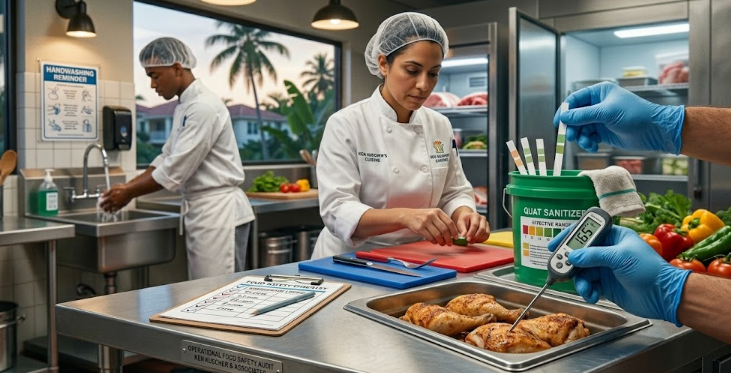
For Florida food service operators, building that kind of team starts with making sure every member holds valid florida food handler certificates. Formal certification isn’t just a regulatory requirement, it’s a signal to your team that you invest in their professional development and a signal to your guests that your operation takes its responsibilities seriously. Operators looking for florida food handler certificates best price can access Ken Kuscher’s resources to keep every team member certified without adding unnecessary cost to an already tight operation.
And when complex situations arise, legal disputes, regulatory matters, liability questions involving food service standards, having a qualified food service expert witness with deep industry expertise provides the authoritative, trust-based guidance that operators and legal teams need most.
The Long Game
Trust is not a campaign. It is not a quarterly initiative or a service standard that gets rolled out and then fades into the background of daily operations. It is a long game, built slowly, protected carefully, and lost quickly the moment complacency sets in.
The restaurants that will define the next decade of the industry are the ones being built on trust right now. Not just on great food or beautiful spaces or clever marketing, but on the daily, unglamorous, essential work of showing up for guests with consistency, honesty, care, and the kind of empowered team culture that makes every interaction feel genuinely human.
With fewer repeat visits up for grabs and less tolerance for experiences that feel impersonal or frustrating, earning loyalty in 2026 depends on delivering personalized service at scale, blending hospitality with technology that works reliably across every touchpoint.
Trust, in the end, is simply the accumulated answer to one question that every guest asks, consciously or not, every time they choose where to spend their time and their money: can I count on you?
The operators who answer that question, not with words, but with consistent, excellent, human-centered action, are the ones who will still be answering it ten years from now.
Florida Food Handler Certificates
Avoid fines by ordering your Florida Department of Business and Professional Regulation-approved Food Worker Program certificates today. They’re available for just $4 each. Program #5552749.
Place your order online here. For additional information, you can call (561) 703-7196.
***Please note that the insightful and engaging content provided on our platform is crafted by our dedicated Marketing Department’s content writing team. While Ken Kuscher is the esteemed figure and expert within our industry, the articles and blog posts available are not personally authored by Ken.